
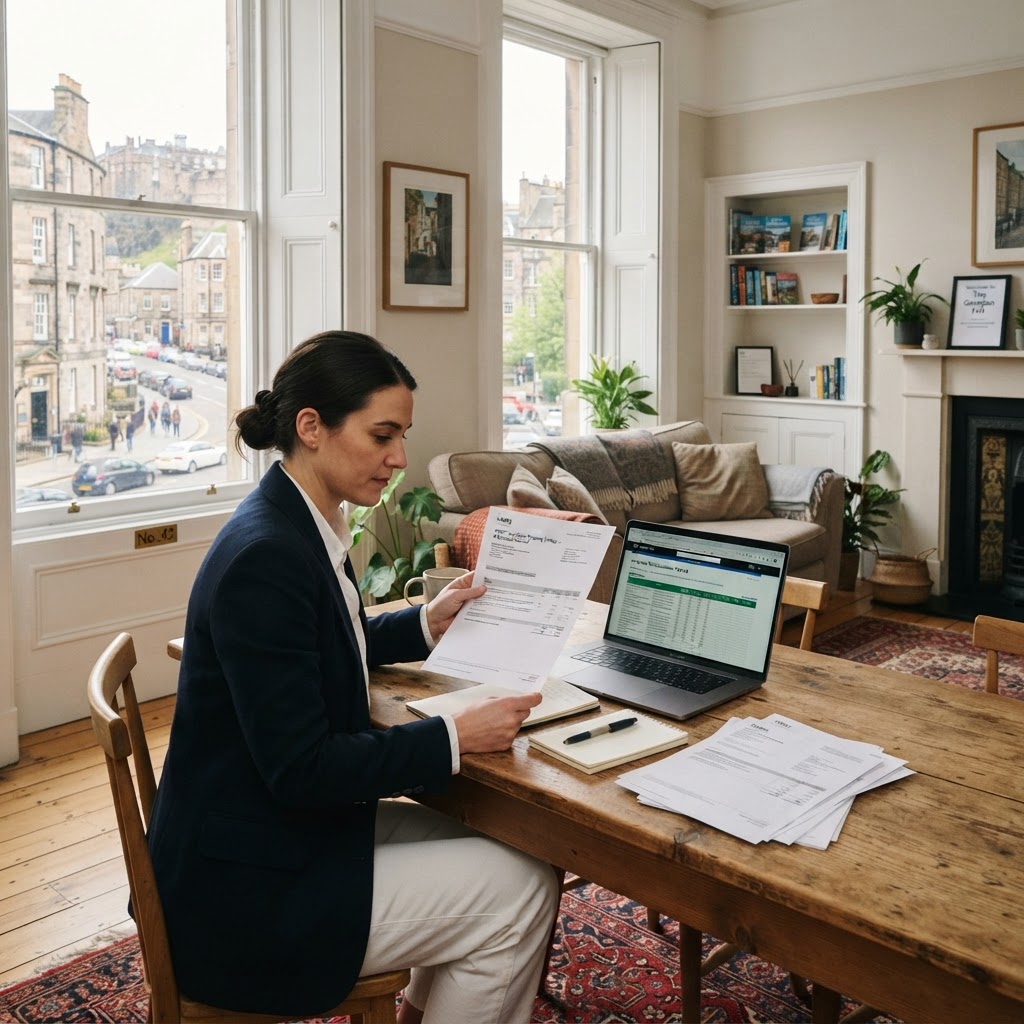
Short-let income is taxable in the UK, and HMRC has become significantly more active in chasing hosts who have not declared it. Whether you rent out a single spare room in Leeds or run five serviced apartments in Manchester, understanding what you owe — and what you can legitimately offset — is essential before your first guest checks in.
Does Airbnb report your income to HMRC?
Yes. Since January 2024, digital platforms including Airbnb and Booking.com have been required under the OECD DAC7 rules to collect and share income data with HMRC. Airbnb began sending annual income summaries to HMRC for all UK hosts, and HMRC cross-references this data against self-assessment returns. The days of undeclared short-let income going unnoticed are effectively over. If you earned money hosting in 2023-24 and did not declare it, you are already in a window where HMRC could raise an enquiry.
Income tax on short-let earnings
Short-let rental income sits within the UK property income regime for most hosts. You add your net rental profit to your other income and pay income tax at your marginal rate — 20% as a basic-rate taxpayer, 40% if you fall into higher-rate territory, and 45% above £125,140. Net profit means your gross rental receipts minus allowable expenses. Allowable expenses for a short-let property typically include cleaning fees, laundry costs, platform commission, property management fees, insurance premiums, utilities where you pay them, maintenance and repairs, and a proportion of mortgage interest (subject to the rules discussed below).
The critical distinction is between capital expenditure and revenue expenditure. Replacing a broken sofa with a like-for-like model is a revenue expense and is deductible in the year you spend it. Refurbishing an entire kitchen to a higher standard is capital expenditure and is not deductible against rental income in the same way — though it may reduce capital gains tax when you eventually sell. Many hosts blur this line and either claim too much or miss out on legitimate deductions. A specialist property accountant pays for itself quickly.
The Furnished Holiday Lettings rules and what changes in April 2025
Until 5 April 2025, properties that qualified as Furnished Holiday Lettings (FHLs) under HMRC rules received a significantly more generous tax treatment than standard buy-to-let. The FHL regime allowed full mortgage interest deductibility (not restricted to basic-rate relief like standard rental properties), capital allowances on furniture and equipment, access to Business Asset Disposal Relief at 10% CGT on sale, and the ability to count FHL profits as relevant UK earnings for pension contributions.
To qualify as an FHL, a property had to be available for commercial letting for at least 210 days per year, actually let for at least 105 of those days, and not occupied by the same person for more than 31 consecutive days for more than 155 days in the year. Many short-let operators in cities like Birmingham and Liverpool structured their businesses specifically around these thresholds.
From 6 April 2025, the FHL regime is abolished. The government confirmed this in the Autumn Statement 2024. Short-let properties will from that point be treated the same as standard residential lettings for tax purposes. This means the mortgage interest restriction that applies to buy-to-let landlords — limiting relief to the basic rate of 20% regardless of your actual tax rate — now also applies to short lets. If you are a higher-rate taxpayer with significant mortgage finance on your short-let property, this materially increases your tax bill. It also means that from April 2025, FHL profits no longer count as relevant earnings for pension contribution purposes, and Business Asset Disposal Relief will no longer apply to short-let property sales in the same way. If you are planning a sale, the timing relative to April 2025 is worth discussing with a tax adviser urgently.
Operators managing properties across cities like Manchester or Leeds who relied on the FHL regime to justify their financing structure need to model the impact carefully. In some cases, a highly leveraged property that was profitable under FHL rules will show a loss on paper under the new regime, despite generating real cash.
The £1,000 property income allowance
If your total gross property income — from all properties, not just short lets — is £1,000 or less in a tax year, you do not need to report it or pay tax on it. This is the property income allowance. For most active short-let hosts this threshold is crossed quickly; even a single busy weekend in a city-centre flat in Liverpool will typically generate more than £1,000 across a year.
Where the allowance is more useful is for hosts who occasionally rent out a room or let their own home for a festival weekend. If your gross receipts are between £1,000 and around £2,500, you can also elect to use the allowance rather than deduct actual expenses, which simplifies record-keeping. Above £2,500 gross, HMRC expects a formal self-assessment return regardless.
VAT and short lets
Residential property rental is exempt from VAT, which means short-let operators do not charge VAT to guests and cannot reclaim VAT on costs. However, the exemption has boundaries. If you are providing substantial additional services alongside accommodation — daily housekeeping, concierge, meals — HMRC may view this as a supply of hotel-type services, which is standard-rated for VAT. The threshold at which VAT registration becomes compulsory is £90,000 of taxable turnover in a rolling twelve-month period (as of the 2024-25 tax year). Very few individual short-let hosts reach this threshold, but operators managing multiple properties under a single trading entity sometimes do.
If you operate through a limited company and the company provides serviced accommodation with hotel-style services, VAT registration may be required sooner than you expect. This catches some operators managing five or more units who have not tracked their cumulative turnover carefully. Seek professional advice if your operation is growing rapidly or if you provide anything beyond basic linen and cleaning between stays.
National Insurance and short-let landlords
Passive rental income — where you simply let a property and do not provide additional services — is not subject to National Insurance. This is one of the reasons some landlords prefer the rental income model to running a more service-heavy operation. However, if HMRC considers your short-let activity to amount to running a business (because of the volume of properties, the level of services provided, or the hands-on nature of your involvement), they may classify the income as trading income, which is subject to Class 4 National Insurance on profits above £12,570 at 6% (2024-25 rates), and Class 2 contributions if applicable.
This distinction matters more than many hosts realise. A host managing fifteen serviced apartments in Birmingham with daily cleaning and a 24-hour guest line is arguably running a trade. A landlord who owns one flat, uses a professional management company to handle everything, and collects rental income quarterly is far more clearly a passive investor. Where you sit on this spectrum affects not only NI but also the way HMRC views your expenses and, critically, how any eventual property sale is taxed.
What records should you keep?
HMRC requires you to keep records for at least five years after the self-assessment filing deadline for the relevant tax year. For short-let hosts, good record-keeping means retaining all platform payout statements (Airbnb provides these in the host dashboard, broken down by month), invoices for every expense you claim, bank statements showing money in and out, and a log of the days each property was available, let, and occupied by the owner. That last point mattered specifically for FHL qualification, but it remains good practice regardless.
Platform payout statements from Airbnb, Booking.com or any other channel (download annually and store as PDFs)
Invoices and receipts for cleaning, laundry, maintenance, management fees, insurance and utilities
Bank statements reconciled to your income and expense totals
A letting log showing available days, booked days and any personal use for each property
Digital accounting software such as Xero or QuickBooks makes this considerably easier. Many operators also link their channel manager data to their accounting software so that income is logged automatically. The more properties you manage, the more this matters — manual reconciliation across six properties on three platforms across a full tax year is a significant task.
The tax picture for short-let operators in the UK is genuinely complex, and the abolition of the FHL regime from April 2025 makes it more so. Everything in this article is provided as general information rather than personal tax advice — your specific situation will depend on your income level, property structure, financing arrangements and trading status, so please speak to a qualified accountant who specialises in property before making decisions.
If you want to understand what your property could earn before worrying about the tax on it, Truestays offers a free income estimate for properties across the UK. You can explore our management service to see how we handle compliance, pricing and guest management — so you can focus on the numbers that matter.
Ready to get started?
Get a free personalised income estimate for your property. No commitment, no pressure.