
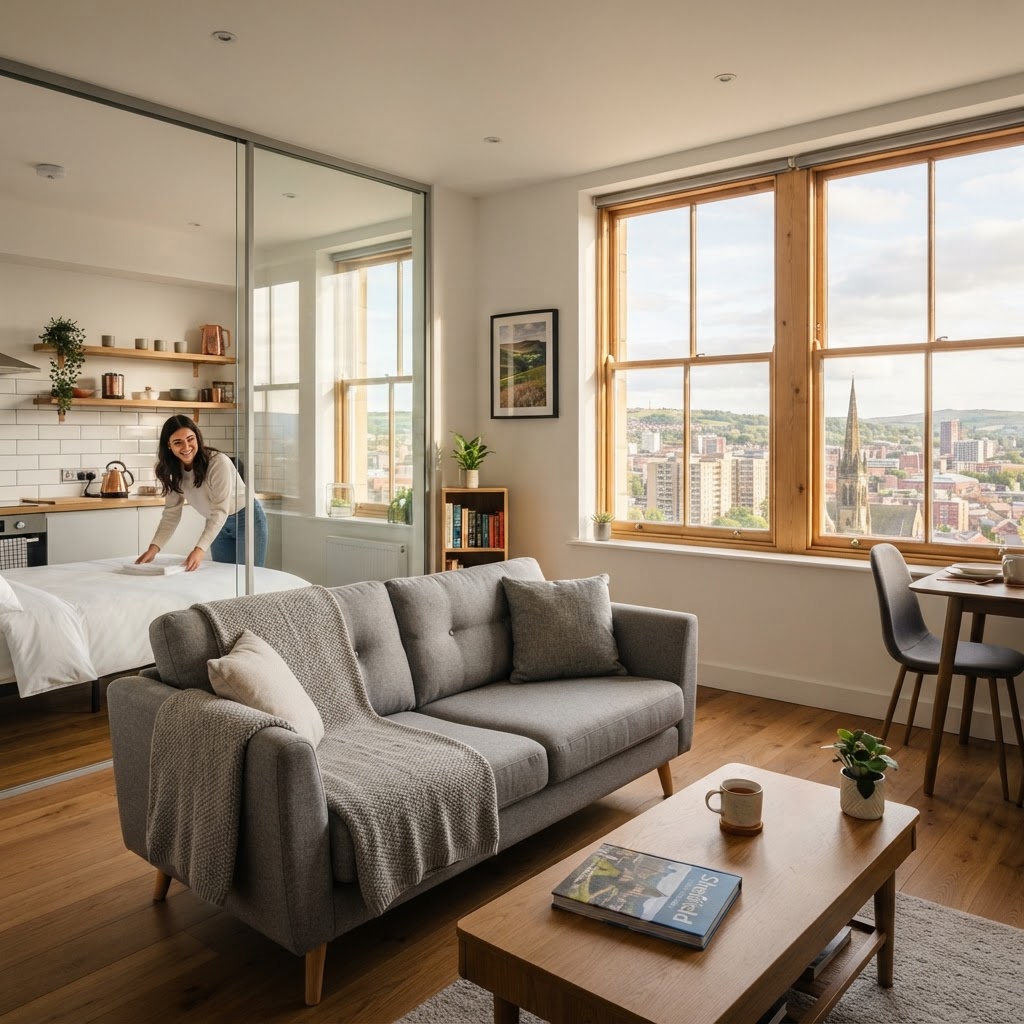
Sheffield sits in an unusual position for short-let operators: it is a large, economically active city that most national property commentators overlook in favour of Manchester or Leeds. That gap between perception and reality is precisely where the opportunity lies. This guide sets out what Sheffield Airbnb properties actually earn, where in the city the numbers are strongest, and what you need to know before committing capital.
What does a typical Sheffield Airbnb earn?
Based on live AirDNA data and our own operator experience managing properties across South Yorkshire, a well-run two-bedroom Sheffield short-let achieves a gross annual revenue of between £22,000 and £30,000. A one-bedroom apartment in a central location typically lands between £16,000 and £22,000 per year. Three-bedroom houses aimed at group stays or contractor accommodation can push past £35,000 in the right postcode.
Average daily rates in Sheffield sit around £90 to £120 for a two-bedroom property, with occupancy rates of 70 to 80 percent achievable for well-managed listings. During peak periods — University of Sheffield graduation weeks in July, the Tramlines Festival, and Sheffield Doc/Fest in June — nightly rates can climb 40 to 60 percent above the baseline without meaningfully hurting occupancy.
One figure that surprises most new Sheffield hosts: the city's contractor and corporate traveller market is proportionally larger than in comparable cities. The advanced manufacturing and healthcare sectors around Waverley, Rotherham Road and the Sheffield Teaching Hospitals NHS Trust generate consistent mid-week demand year-round. This keeps occupancy steadier than leisure-only markets and reduces the seasonal income swings that affect coastal and tourist destinations.
Which Sheffield areas perform best for short lets?
The city centre — specifically the S1 and S3 postcodes covering the Cultural Industries Quarter, Kelham Island and Devonshire Green — is the strongest short-let corridor. Kelham Island in particular has seen significant regeneration over the past decade, and its independent restaurant and bar scene makes it genuinely appealing to leisure guests. A two-bedroom apartment in Kelham Island with good photography and dynamic pricing will regularly achieve £110 to £135 per night at weekends.
Ecclesall Road South (S11) and Nether Edge perform well for longer minimum stays and professional guests. Properties here tend to attract the 3 to 7 night stays rather than the weekend party crowd, which means lower turnover costs and better review consistency. This corridor is worth considering if you want to minimise management complexity without sacrificing income.
The student-heavy postcodes around Broomhill and Crookes (S10) can work but demand more careful positioning. Competition from private student lets inflates supply in certain months, and you need a clear guest profile — academic visitors, visiting academics, short research placements — to stay consistently occupied outside peak university periods. We would not recommend S10 as a first short-let investment unless you already have an asset there.
The Lower Don Valley and the areas around Attercliffe and Meadowhall are emerging for contractor accommodation. Yields are lower in absolute terms but the demand is reliable and the purchase prices are more accessible. A well-presented one-bedroom flat purchased for £130,000 to £150,000 in this area can still generate gross short-let income of £14,000 to £18,000 per year, which represents a stronger gross yield than most comparable long-let scenarios.
What types of property work best in Sheffield?
Sheffield's topography — the city famously has more hills than Rome — means that properties with parking carry a premium. A listing without off-street parking or easy permit parking in S1 or S11 will consistently underperform against comparable properties that offer it. This is one of Sheffield's specific quirks that national Airbnb income calculators will never flag.
Apartments in converted Victorian and Edwardian mill buildings perform particularly well for photography and positioning. The exposed brick and high ceilings of Kelham Island and nearby areas photograph exceptionally well and attract the premium leisure segment willing to pay 20 to 30 percent above the market rate for aesthetic appeal. New-build apartments in generic developments, while easier to manage, tend to compete on price rather than differentiation and cap out at lower nightly rates.
For group bookings, three and four-bedroom terraced houses in S2 and S8 — areas like Heeley, Meersbrook and Sharrow — are increasingly popular with hen and stag groups, large family visits and sports travel (Sheffield United and Sheffield Wednesday both generate overnight demand). These properties require more robust house rules and management but can achieve £250 to £350 per night for full-property bookings at weekends.
What affects your Sheffield Airbnb income?
Management quality is the single biggest variable. Two identical Sheffield properties managed differently can have a £6,000 to £8,000 annual income gap purely due to listing optimisation, response rates, pricing strategy and review management. If you are self-managing, the learning curve is real, and the time cost is significant. If you are using a management company, the quality of local operators varies considerably — a national firm with no Sheffield-specific knowledge will not outperform a locally embedded team.
Pricing strategy deserves particular attention in Sheffield. The city's event calendar is dense but not always well-publicised. University open days, Ponds Forge sporting events, Sheffield Arena concerts and NHS Trust conference weeks all create demand spikes that generic pricing tools will miss without local calibration. Working with a team that monitors the local events calendar manually makes a measurable difference to annual revenue. Our pricing approach is built around exactly this kind of local context rather than relying solely on algorithm-driven rate setting.
Furnishing and photography also matter more than most landlords expect. Sheffield guests searching on Airbnb are comparing your listing against hundreds of alternatives, and the difference between a professional photograph of a well-styled kitchen and a smartphone photo of the same room can account for a 15 to 20 percent difference in click-through and conversion rates. Visit our interiors guide for practical advice on fitting out a short-let property to a standard that converts browsers into bookings.
Short-let vs long-let in Sheffield: do the numbers work?
A two-bedroom apartment in S1 or S3 that would let for approximately £900 to £1,050 per month on a standard AST — generating £10,800 to £12,600 per year — can realistically achieve £22,000 to £28,000 gross as a short-let. After management fees (typically 18 to 25 percent), cleaning, laundry, restocking and maintenance, net short-let income for a well-managed property typically lands at £16,000 to £21,000 per year. That is still a significant premium over long-let returns for most property types in Sheffield.
The caveat is void periods and management effort. Short-letting requires active management, and income is not guaranteed in the way rent is. A property sitting empty for two weeks during a poorly managed transition between bookings costs real money. The financial case for short-letting in Sheffield is strong, but it depends entirely on execution. Landlords who go in underprepared tend to revert to long-letting after six months, having neither maximised income nor covered the costs of the switch.
Tax treatment is another area where the two models diverge. Furnished holiday let rules have changed significantly following the Spring 2024 Budget, with the FHL regime abolished from April 2025. This affects the tax efficiency of short-letting for some landlords. The specifics depend heavily on your individual circumstances, ownership structure and income profile, so take professional advice from a qualified accountant before making decisions based on tax treatment alone.
Is Sheffield worth it for short-let investment?
Sheffield offers something increasingly rare in UK short-let markets: genuine demand diversification. You have leisure guests drawn by the city's food and culture scene, contractor and corporate stays generated by manufacturing and healthcare, university-related travel year-round, and a growing sports tourism segment. That mix reduces the risk of any single demand driver collapsing and taking your occupancy with it.
Purchase prices remain competitive relative to the income potential. A city centre apartment at £180,000 to £220,000 generating £22,000 to £26,000 gross per year stacks up well against equivalent assets in Leeds or Manchester, which now require significantly higher acquisition costs for similar returns. Sheffield is not without its challenges — parking, postcode specificity and management quality all require careful attention — but for investors who do their homework, it remains one of the better-value short-let markets in the North of England.
Sheffield also has relatively low short-let saturation compared to its population size and visitor economy. The pipeline of new Airbnb listings entering the market is slower than in Leeds or Liverpool, which means well-positioned properties are not being undercut by a flood of new supply. That window will not stay open indefinitely, but it is real right now.
If you own a property in Sheffield or are considering a purchase, Truestays can give you a free income estimate based on the specific postcode, property type and configuration. Visit our Sheffield management page or get in touch directly to find out what your property could realistically earn under professional management.
Ready to get started?
Get a free personalised income estimate for your property. No commitment, no pressure.