
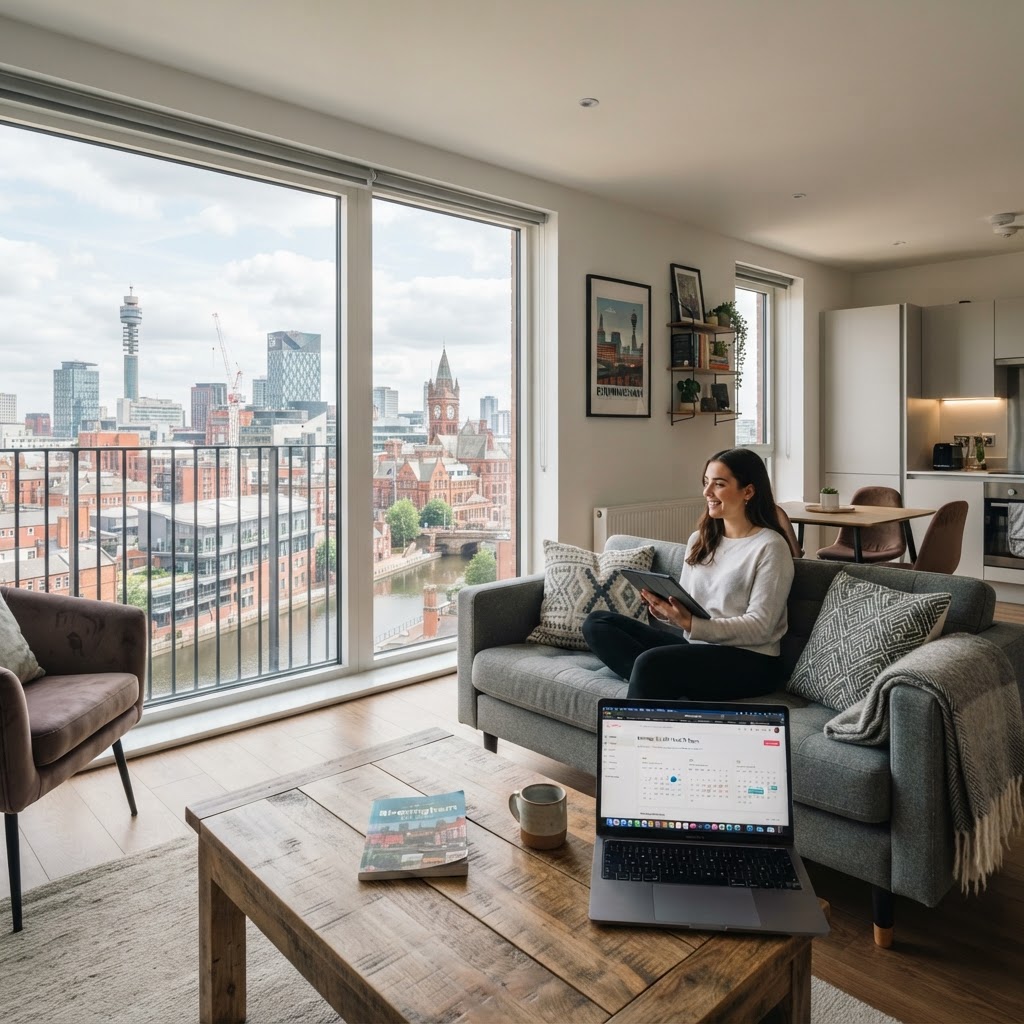
Birmingham is the UK's second-largest city and one of the most searched short-let markets outside London, yet the income figures quoted online vary wildly. Some sources cite average nightly rates of £80; others push numbers closer to £200. The gap usually comes down to property type, location within the city, and how well the listing is managed.
What do Birmingham Airbnb properties actually earn?
Based on live market data and properties we manage directly, a well-presented one-bedroom apartment in Birmingham city centre typically achieves between £65 and £95 per night on average across the year, with occupancy running at 72–82%. That translates to a gross annual revenue of roughly £17,000 to £25,000 before costs. A two-bedroom apartment in the same area can comfortably reach £28,000 to £38,000 gross, particularly if it is positioned near Brindleyplace or the Jewellery Quarter.
Three-bedroom houses in areas like Harborne or Moseley — especially those with a garden or private parking — are capable of £40,000 to £55,000 gross annually when managed well and kept to a high standard. The key phrase there is managed well. Properties that sit on default Airbnb pricing with average photos will earn considerably less, often 30–40% below what the same property could achieve with active rate management and a strong listing.
Peak nightly rates during major events can push well beyond these averages. During Birmingham 2022 Commonwealth Games, operators saw nightly rates above £300 for central properties. That was an exceptional spike, but it demonstrated how elastic demand can be in this city when the right event lands.
Which areas of Birmingham perform best for short-lets?
Not all of Birmingham performs equally, and the differences between postcodes can be significant. The city centre — particularly the B1, B2 and B3 postcodes covering Broad Street, Brindleyplace and the Colmore Business District — delivers the most consistent year-round occupancy. Corporate travellers, conference attendees and weekend visitors all drive demand here, which means you are not relying on leisure bookings alone.
Digbeth has become increasingly attractive as the HS2 regeneration work and the creative quarter development have drawn a younger, longer-staying demographic. Short-lets here can catch both leisure guests and contractors working on major construction projects nearby. Average nightly rates in Digbeth sit slightly below the prime city centre but occupancy is often comparable.
For family-sized properties, Harborne and Moseley consistently outperform other suburban areas. Both offer good transport links, proximity to the Queen Elizabeth Hospital campus — which generates steady contractor and medical professional demand — and a genuine neighbourhood feel that guests actively seek out. Sutton Coldfield performs well for premium family houses, particularly for guests attending NEC events or weddings at the many venues in north Birmingham and Warwickshire.
Areas to approach more cautiously include parts of Erdington, Handsworth and some sections of south Birmingham further from transport. These can work for the right property type but occupancy is more volatile and average nightly rates are lower, which compresses your margin once costs are factored in.
What drives demand in Birmingham throughout the year?
Birmingham's demand profile is more diversified than many UK cities, which is one of its genuine strengths as a short-let market. The NEC is one of the busiest exhibition and events venues in Europe, hosting over 500 events annually including the Crufts dog show, Spring Fair and the BETT education technology conference. Each of these pulls thousands of visitors who book short-lets rather than hotels for multi-night stays.
The city also has a large professional and corporate travel market. HSBC's UK headquarters are in Birmingham, as are several other major financial and professional services firms that relocated under various post-pandemic restructuring programmes. Contractors working in the city centre and around the HS2 Curzon Street terminus development have provided a steady stream of mid-term bookings — stays of two to six weeks — which are highly valuable because they reduce cleaning and management frequency while keeping revenue strong.
Leisure demand peaks in spring and summer, particularly around the Bullring and Grand Central shopping complex, Cadbury World in Bournville, and the cultural programme at Birmingham Museum and Art Gallery. Villa Park and St Andrew's (once Birmingam City return to it) both drive short booking windows around match days, particularly for away supporters, though these tend to be single-night stays rather than high-value multi-night bookings.
How does Birmingham compare to other UK cities?
Birmingham sits in the middle tier of UK short-let markets in terms of achievable revenue. It is not London or Edinburgh, where nightly rates for a one-bedroom flat can exceed £150 on an average night, but it comfortably outperforms many northern cities in terms of consistency. If you are weighing up Birmingham against other Midlands options, it is worth knowing that Coventry and Nottingham both have active short-let markets but smaller corporate demand bases, which means more reliance on weekend leisure bookings.
Compared to Leeds or Liverpool, Birmingham tends to have slightly higher average daily rates for city centre apartments but similar occupancy. The corporate demand from the NEC and the city's financial district creates a floor that pure leisure markets do not have. Manchester remains the strongest regional city for short-let revenue overall, but Birmingham's lower property acquisition costs mean that gross-to-yield ratios can actually be more favourable here for investors buying now.
What are the costs you need to account for?
Gross revenue figures are only meaningful once you understand what sits beneath them. For a Birmingham city centre apartment, typical annual operating costs for a short-let include management fees (usually 15–25% of revenue if using a professional operator), cleaning (which scales with turnover and is one of the largest variable costs), utilities, platform fees from Airbnb or Booking.com, and ongoing maintenance. On a property generating £28,000 gross, net operating income after these costs is often in the range of £16,000 to £20,000, depending on how the property is set up and managed.
There are also fixed costs to consider: buildings and specialist short-let contents insurance, any service charges and ground rent if the property is leasehold (common in Birmingham city centre apartment buildings), and council tax. The council tax question is important — short-let properties in England may be subject to council tax or business rates depending on the number of days let per year, and the rules around this are worth understanding clearly before you start. Always take professional advice on the tax treatment of your short-let income for your specific situation, as it depends on factors including your overall income, property ownership structure and the nature of the lettings.
Management fees: 15–25% of gross revenue depending on the operator and service level
Cleaning: typically £50–£90 per turnover for a one-bedroom, £80–£130 for a two-bedroom
Utilities (if included): £150–£250 per month for a city centre apartment
Platform fees: approximately 3% host fee on Airbnb, up to 15% for some OTA models
Maintenance and consumables: budget £1,200–£2,500 per year for an actively let property
Is Birmingham worth it for a short-let investment?
For the right property in the right location, yes. The city's combination of corporate demand, event-driven spikes and improving infrastructure makes it a more resilient short-let market than many give it credit for. The HS2 development, regardless of the political controversy around it, has already changed how Birmingham is perceived by business travellers and investors, and that shift is reflected in booking patterns.
One thing experienced operators know that is easy to miss from the outside: the best-performing Birmingham properties are not always the most central ones. A three-bedroom house in Harborne with off-road parking, fast broadband and a well-equipped kitchen will regularly outperform a city centre studio on a revenue-per-square-foot basis, because it attracts a completely different — and less price-sensitive — guest type. The families travelling for hospital appointments, the relocation candidates doing a week of house viewings, the small group of friends at an NEC trade show: these guests book further in advance and stay longer.
Where Birmingham can catch operators out is in leasehold restrictions. A significant proportion of city centre new-build apartment stock has short-let restrictions written into the lease, either outright prohibitions or clauses requiring freeholder consent. This is not unique to Birmingham — it affects London and other cities too — but it is particularly prevalent in the post-2010 apartment blocks that look attractive on paper. Always have a solicitor check the lease before purchasing or listing a leasehold property as a short-let.
If you want to know what your specific Birmingham property could realistically earn — based on its location, size and current market conditions rather than generic averages — Truestays offers a free income estimate with no obligation. It takes a few minutes and gives you a grounded starting point for any investment decision.
Ready to get started?
Get a free personalised income estimate for your property. No commitment, no pressure.