
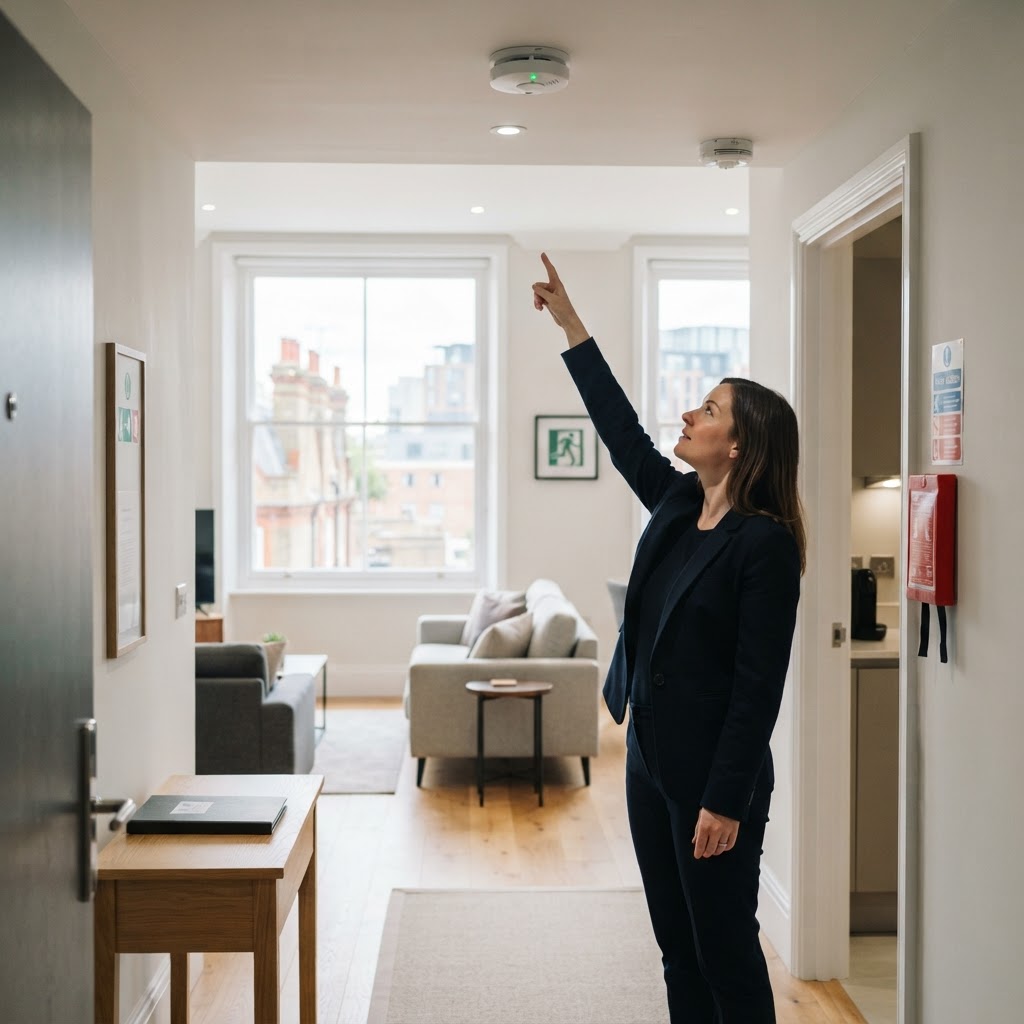
Fire safety is one of the areas where short-let operators can inadvertently fall into serious legal exposure without realising it. The rules that apply to your property depend on how it is classified, how many guests it accommodates, and in some cases the building it sits within. Getting this wrong is not a paperwork issue — it is a criminal liability issue.
Why fire safety rules apply differently to short lets
A standard residential property occupied by its owner or a long-term tenant sits under a relatively light fire safety regime. The moment you start taking paying guests on short-term bookings, the picture changes. Properties used for short-term letting are generally treated as "higher risk" premises under fire safety law because the occupants are unfamiliar with the layout, may not know where exits are, and could be sleeping when a fire starts.
The key piece of legislation is the Regulatory Reform (Fire Safety) Order 2005, which applies to non-domestic premises in England and Wales — and which can apply to parts of a building even where individual units are residential. If your short let is a flat within a purpose-built block, you and the building's responsible person (often the freeholder or managing agent) both carry obligations. The 2022 Fire Safety Act and the Building Safety Act 2022 have extended these duties further, particularly for buildings above 11 metres in height. Scotland operates under the Fire (Scotland) Act 2005 and associated regulations, which carry similar duties but with some procedural differences.
For a standalone house let on Airbnb to up to six guests, the practical obligations are less complex than for a large apartment in a high-rise in Manchester or a ten-bed group property in the Lake District. But the principle is the same: you must take reasonable steps to protect guests from fire, and you must be able to demonstrate that you have done so.
Fire risk assessments: what they are and who needs one
A fire risk assessment is a structured review of your property that identifies fire hazards, the people at risk, and the measures needed to reduce that risk to an acceptable level. For most short-let operators running properties that sleep up to six people and do not share communal areas with the public, a competent owner can carry out and document this assessment themselves. For larger properties, properties within mixed-use buildings, or anything that accommodates more than six guests, you should use a qualified fire risk assessor.
The assessment should be written down and kept on file. It needs to cover ignition sources (cookers, heaters, electrical equipment), fuel sources (furnishings, curtains, stored items), means of escape, fire detection and warning, firefighting equipment, and the information guests are given on arrival. Critically, it must be reviewed whenever there is a material change to the property — a renovation, a change in the maximum occupancy, or new guidance from your local fire authority. Many operators carry out a formal review annually as a matter of course.
From our experience managing properties across cities including Birmingham, Leeds and Liverpool, the assessment itself is rarely the issue — it is the ongoing record-keeping that catches operators out. If a guest is injured and you cannot produce a current assessment, you have very limited defence.
Alarms, detection and emergency lighting
Since 1 October 2022, the Smoke and Carbon Monoxide Alarm (Amendment) Regulations 2022 have required landlords in England to fit a smoke alarm on every storey and a carbon monoxide alarm in any room with a fixed combustion appliance (which includes gas boilers and log burners, but not gas cookers under current guidance). These rules apply to short lets. Scotland has gone further: since February 2022 all Scottish homes must have interlinked smoke alarms in the living room and in circulation areas on each storey, plus heat alarms in kitchens, and carbon monoxide detectors where relevant. Wales and Northern Ireland have their own requirements that are broadly similar in intent.
For short lets specifically, interlinked alarms are strongly advisable even where not yet mandated, because guests will not know from experience which alarm has triggered. If an alarm sounds in a ground-floor kitchen and the guest is asleep on the second floor, an interlinked system means every alarm in the property activates simultaneously.
Emergency escape lighting — lights that activate automatically if the mains power fails — is a requirement in many shared or larger properties and is best practice in any property where guests may not easily find their way out in the dark. For a compact two-bedroom flat this is often addressed with a single maintained emergency light above the front door. For a larger property with multiple floors and corridors, a full emergency lighting scheme may be needed.
Furnishings, escape routes and fire doors
All upholstered furniture supplied in a short-let property must comply with the Furniture and Furnishings (Fire Safety) Regulations 1988 (as amended). This means sofas, armchairs, headboards, mattresses and similar items must carry the permanent label confirming compliance. Second-hand furniture from auctions or private sales frequently lacks this label, which means it should not be used in a commercially let property. This catches out a significant number of new operators who furnish on a budget.
Means of escape must be kept clear at all times. Hallways and stairwells should not be used for storage, furniture should not obstruct routes to exits, and all exit doors must be operable without a key from the inside. This last point is worth checking physically in every property you manage — some older properties have mortice locks on rear doors that guests simply cannot open in an emergency.
Fire doors are a more complex area. In a house converted into flats, or in any HMO (House in Multiple Occupation), fire doors with intumescent strips and self-closing mechanisms are typically required between rooms and on escape routes. For a single-dwelling short let that is not classified as an HMO, fire doors are not always mandatory, but they are increasingly expected by insurers and are referenced in many local authority licensing conditions. If your property is in a managed building in London or Manchester, check what the freeholder's fire safety certificate requires, because obligations for communal areas flow down to individual unit operators.
What platforms and insurers expect
Airbnb's host standards do not substitute for legal compliance, but they do create an additional layer of expectation. Hosts are required to confirm they have working smoke and CO alarms and are asked to disclose whether a property has security cameras or other monitoring devices. Some insurers specifically ask whether a formal fire risk assessment has been completed when you apply for short-let specific cover. If you say yes and you have not actually done one, that is a potential grounds for voiding a claim.
Short-let specific insurance policies from providers such as Pikl, Guardhog or Supercover generally include public liability cover, but the underlying policy conditions almost always require you to comply with all relevant legislation. A fire that results in a guest injury, and that occurs in a property without working alarms or a current risk assessment, will face intense scrutiny from the insurer's loss adjusters. The cost of getting fire safety right is modest — a professional risk assessment for a three-bedroom property typically costs between £150 and £350. The cost of getting it wrong is potentially unlimited.
Staying compliant as rules change
Fire safety regulation for short lets is not static. The Building Safety Act 2022 introduced a new regime for higher-risk buildings that is still being implemented, and secondary legislation is expected to extend some duties. The short-let registration scheme being developed across England will likely incorporate fire safety declarations as a condition of registration when it comes into force. Scotland's scheme, which is already live in some form, includes safety declarations as a core element.
Practically, the best way to stay ahead of this is to treat fire safety as an operational standard rather than a one-off compliance exercise. Review your risk assessment every twelve months, check alarm batteries and test units monthly, replace any furniture that loses its compliance label, and keep a simple log of all checks. Local fire authorities in England will carry out free fire safety visits for certain property types — it is worth contacting your local brigade if you have any uncertainty about a specific property.
Fire safety law touches planning, building regulations, landlord law and health and safety legislation simultaneously. The overview above is intended as a practical starting point, but you should seek advice from a qualified fire risk assessor or solicitor for your specific property and circumstances.
If you are considering how a well-managed short let operates in practice, Truestays handles compliance, maintenance and guest management for operators across the UK. You can get a free income estimate for your property at truestays.com — no obligation, just a clear view of what your property could earn.
Ready to get started?
Get a free personalised income estimate for your property. No commitment, no pressure.